

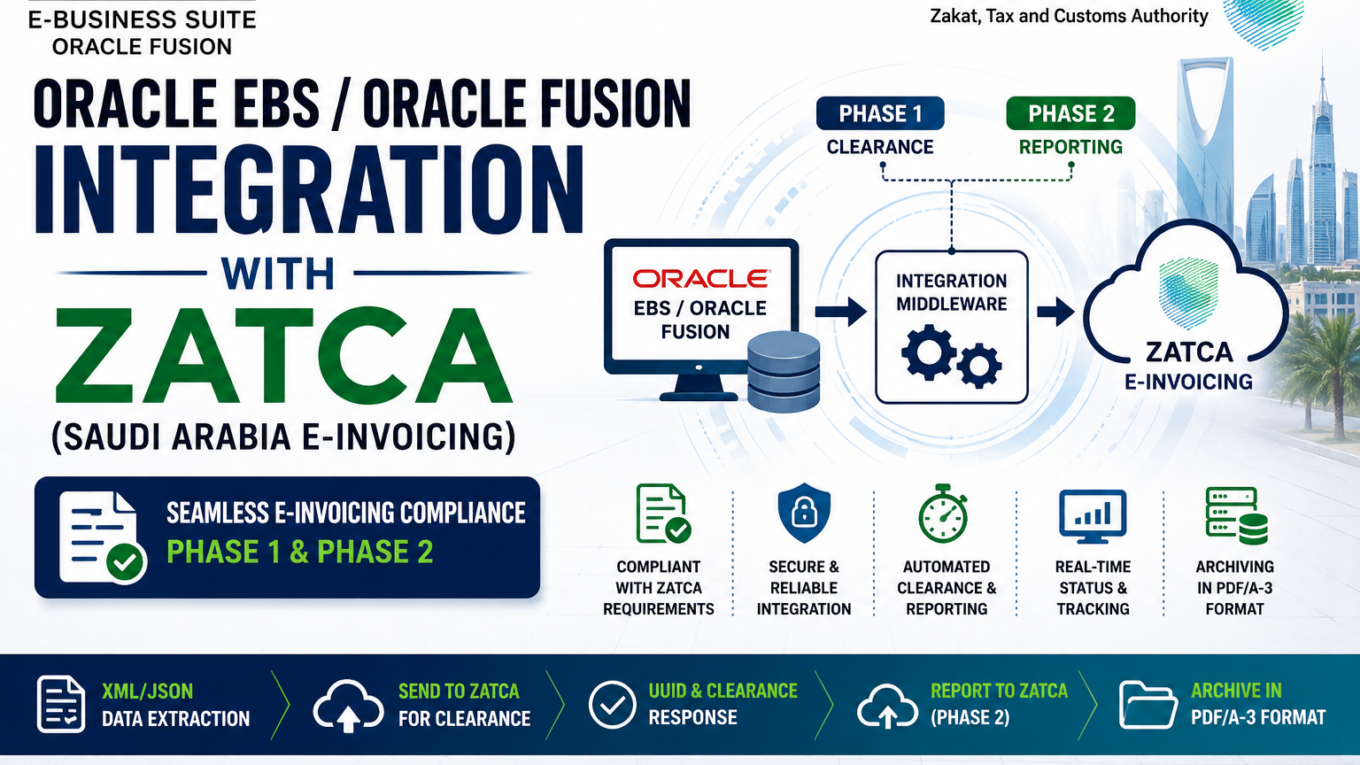
Oracle EBS / Oracle Fusion Integration with ZATCA (Saudi Arabia E-Invoicing)
Businesses operating in Saudi Arabia must comply with the e-invoicing regulations issued by the Zakat, Tax and Customs Authority (ZATCA). These regulations require organizations to generate, validate, and report electronic invoices directly to the ZATCA platform.
Organizations using Oracle E‑Business Suite (EBS) or Oracle Fusion Cloud ERP must ensure their ERP systems are properly integrated with the ZATCA e-invoicing system to remain compliant.
In this article, we will explore the ZATCA integration requirements, architecture overview, and how Oracle ERP systems can be connected with ZATCA services.
What is ZATCA E-Invoicing?
ZATCA introduced electronic invoicing (FATOORA) to digitize the invoicing process in Saudi Arabia. The system requires businesses to generate structured invoices and share them with ZATCA in real time or near real time.The e-invoicing initiative was implemented in two phases:
Phase 1 – Generation Phase
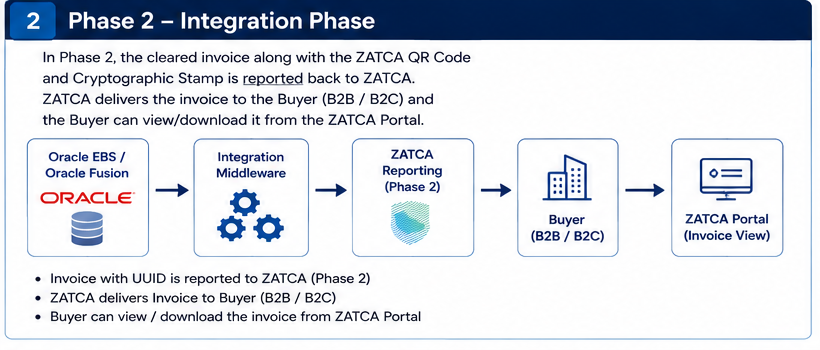
Phase 2 – Integration Phase
What is PDF/A-3 Format?
PDF/A-3 is an archival version of PDF that allows embedding additional files inside the PDF document. In ZATCA e-invoicing, this feature is used to embed the UBL XML invoice within the PDF invoice.
This means a single invoice document contains:
- A visual invoice layout for humans (PDF)
- A structured XML invoice for system validation (embedded XML)
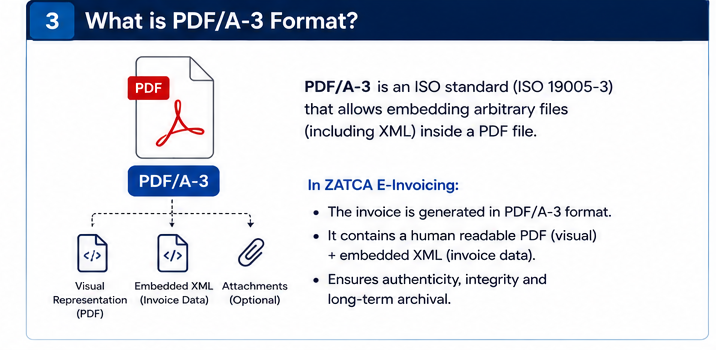
This approach ensures both readability and regulatory compliance.
ZATCA E-Invoicing Phase 1 vs Phase 2 – Special Field Comparison
The Zakat, Tax and Customs Authority (ZATCA) introduced e-invoicing (FATOORA) in two major phases. Each phase introduces additional technical requirements for invoice generation and validation.
Organizations using ERP systems such as Oracle E-Business Suite or Oracle Fusion Cloud ERP must ensure that their invoice data structure supports these required fields.
The table in the image highlights the special technical fields introduced in Phase 1 and Phase 2 and how they appear in the invoice.

ZATCA E-Invoicing Integration Architecture
The diagram illustrates a typical integration architecture between enterprise ERP systems and the ZATCA e-invoicing platform. Businesses using ERP systems such as Oracle E-Business Suite, SAP ERP, Microsoft Dynamics 365, Microsoft Dynamics NAV, Sage ERP, or other custom ERP/POS solutions must integrate their invoice processing systems with the Zakat, Tax and Customs Authority (ZATCA) platform.
This integration allows organizations to generate compliant invoices and communicate directly with the ZATCA Fatoora Portal for validation, clearance, and reporting.

Standard Tax Invoice Generation Flow in Phase II
A standard tax invoice is generally the B2B invoice. In Phase 2, it follows the clearance model, which means the invoice must be sent to ZATCA first and cleared before it is shared with the buyer. That is the big difference from a simplified invoice, which follows reporting instead of prior clearance.

Simplified Tax Invoice Generation Flow
A simplified tax invoice is a lighter version of the full tax invoice under KSA VAT rules, generally used for business-to-consumer transactions. It has fewer mandatory fields than a standard tax invoice.
ZATCA phase II rollout plans are available in following link.
Support for ERP Integration:
If you need to integrate your ERP system with ZATCA or are facing any difficulty in meeting the e-invoicing requirements, you can contact us for support. We can help you navigate the rollout phases and support your compliance and integration journey. Email: info@erphints.com